
What Should a Well-Child Visit Note Capture at Each Age? A Bright Futures Guide for Independent Pediatric Practices
What a well-child note must document from the newborn visit to age 21: the Bright Futures screens due at each age, a by-age table, and the gaps that get missed.

A well-child visit note has to carry the same core sections at every age: the parent's or patient's concerns, interval history, developmental surveillance, the screenings due for that age, growth, the exam, immunizations, an assessment and plan, and the anticipatory guidance you gave. What changes from visit to visit is the content inside those sections. The AAP Bright Futures periodicity schedule sets which screens fall due when, and that is where most notes go wrong.
This guide walks through the schedule from the newborn visit to age 21. It covers what each stage of the note has to capture, and how independent and direct-care pediatric practices can build the structure into their templates instead of rebuilding it from memory at each visit.
How many well-child visits does Bright Futures recommend?
Bright Futures sets out a preventive visit at 3 to 5 days, at 1, 2, 4, 6, 9, 12, 15 and 18 months, at 2, 2½, 3 and 4 years, and then once a year through age 21. That comes to 30 visits per child, and each has its own set of screenings. A pediatric practice that writes these notes from one generic "well visit" template ends up relying on memory for the parts that change, which are also the parts a chart audit or a payer review will look for.
One way to keep this manageable is to group the visits by stage, so the note's structure follows the child's development:
- Infancy (newborn to 9 months): feeding, elimination, sleep, the newborn screen results, and the birth parent's well-being
- Early childhood (12 months to 4 years): developmental and autism screening, lead and anemia, oral health and fluoride, and the first vision and hearing screens
- Middle childhood (5 to 10 years): school, behavior, acuity and audiometry, and the first lipid screen
- Adolescence and young adulthood (11 to 21 years): a confidential psychosocial interview, mental health and substance use screening, sexual health, and the move to adult care
What does the note need to capture at each age?
The table below lists the screenings a well-child note should account for at each stage, following the Bright Futures schedule. "Account for" matters here. Every item should have a result, a risk assessment, or a documented reason it was not done. A blank line looks the same as a screen that was missed.
| Visit | Screenings to document | Note focus |
|---|---|---|
| Newborn (3 to 5 days) | Newborn blood screen, hearing screen, critical congenital heart disease screen (pulse oximetry), bilirubin, hepatitis B risk | Birth history, feeding, jaundice, family adjustment |
| 1 to 6 months | Newborn screen results, postpartum depression screen for the birth parent (e.g. EPDS), behavioral screen; fluoride varnish and lead risk from 6 months | Feeding, sleep position, readiness for solids |
| 9 months | Developmental screen (ASQ-3 or SWYC), oral health, fluoride | Milestones across four domains |
| 12 to 15 months | Hemoglobin or hematocrit, lead screen, tuberculosis risk, dental home | Weaning, nutrition, behavior |
| 18 months to 2½ years | Developmental screen at 18 and 30 months, autism screen (M-CHAT-R/F) at 18 and 24 months, lead screen at 24 months, dyslipidemia risk | Language, toilet-training readiness, screen time |
| 3 to 4 years | Instrument-based or acuity vision screen, audiometry from 4, fluoride varnish | Preschool readiness, behavior |
| 5 to 10 years | Visual acuity and audiometry on the scheduled years, anxiety screen from 8 (e.g. SCARED), lipid screen once between 9 and 11, behavioral screen (e.g. PSC-17) | School, friendships, activity, blood pressure |
| 11 to 14 years | Depression (PHQ-A) and suicide risk (ASQ) from 12, anxiety, substance use (CRAFFT), STI and HIV risk, sudden cardiac arrest risk, high-frequency audiometry once | Confidential HEADSSS interview, puberty |
| 15 to 21 years | Depression, suicide risk, anxiety, CRAFFT, HIV once between 15 and 21, lipid screen once between 17 and 21, hepatitis C once from 18, cervical cancer screening from 21 | Confidential interview, driving, moving to adult care |
Immunizations, growth and the physical exam are documented at every visit. The exam itself changes with the stage. An infant exam checks the fontanelle, red reflex, hips (Ortolani and Barlow) and femoral pulses. A school-age exam adds a forward-bend check for scoliosis, and an adolescent exam records Tanner stage when it is examined.
What goes wrong most often in well-child documentation?
Three problems come up again and again:
- Screens documented by default. A template that comes pre-filled with "low risk" or "passed" records a reassuring result whether or not the screen was done. A result should come from the visit itself, or the line should stay open until someone fills it in.
- Milestones checked without evidence. "Development on track" is not the same as observing or hearing that the child does each specific thing. Surveillance is only useful when each checked milestone has a source.
- Anticipatory guidance copied wholesale. Pasting every guidance topic for the age into the note claims counseling that never happened. The note should list the advice that was actually given.
How should a note handle adolescent confidentiality?
From about age 11, part of the visit should happen without the parent in the room. The note needs to record that this happened, along with what the adolescent shared about home, school, activities, drugs, sexuality, mood and safety (the HEADSSS framework). That part of the note should also be kept apart from anything a parent or proxy can read. For a family membership practice, where the parent often pays and holds portal access, this needs a deliberate structure: a separate, clearly marked section that the clinician knows not to release. Minor-consent rules vary by state, so the practice's policy should follow its state's law.
How does SigmaMD support well-child documentation?
SigmaMD's Template Library includes a SigmaMD-written note template for each well-child visit on the Bright Futures schedule, from the newborn visit through the 18-to-21-year visit, with school-age and adolescent years grouped into bands. A practice adds the ones it wants to its own templates and edits them to match how its clinicians work. Its copy belongs to the practice, and later changes to the library version do not overwrite it. Each template carries the sections described above, with that age's screenings, milestones by domain, stage-appropriate exam lines, and the ICD-10 well-visit codes for the age.
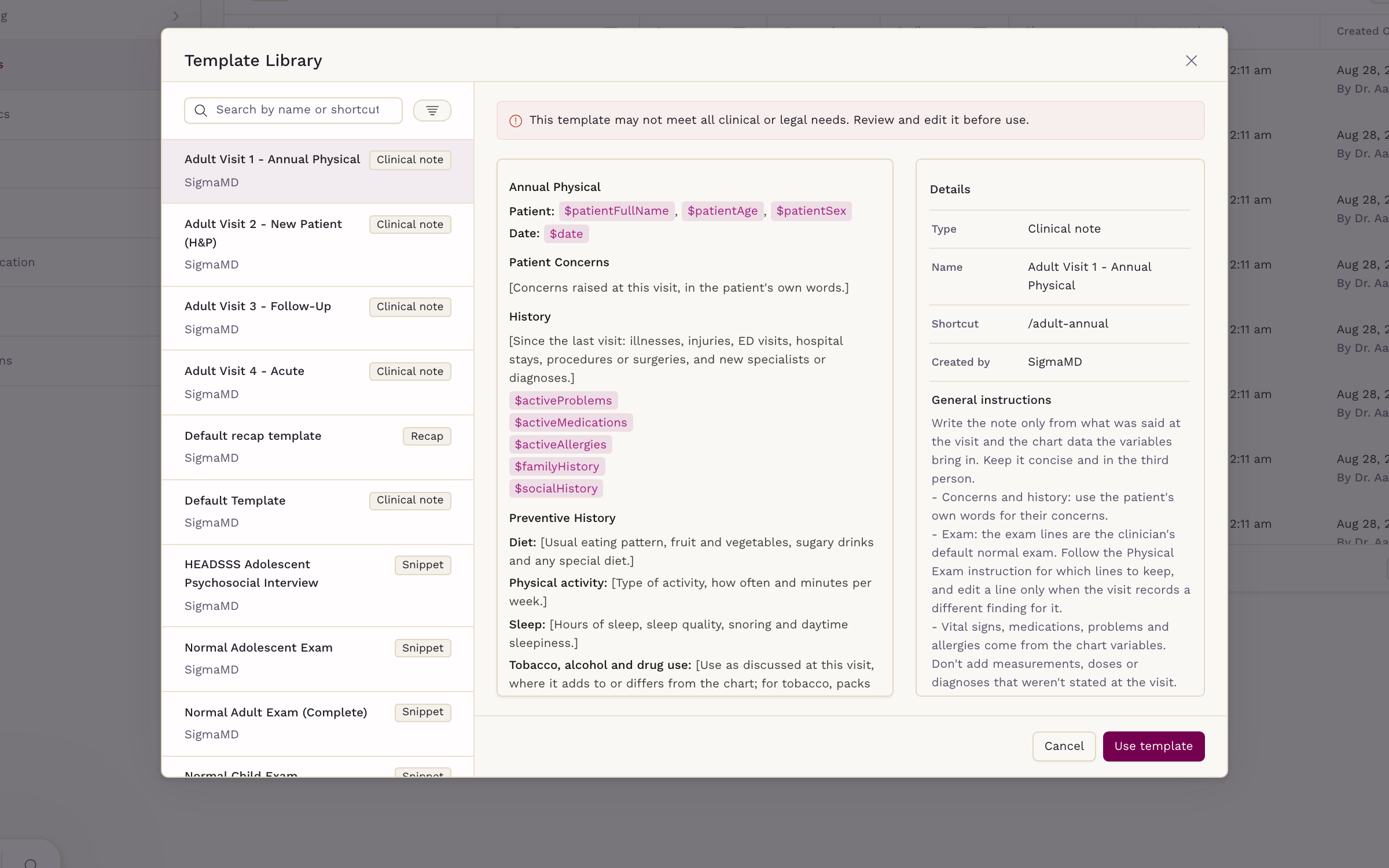
In SigmaMD, the templates handle the three problems above directly:
- The Screening section is a sign blocker. A note from the template cannot be signed until every screening line has been filled in, so a missed screen gets caught before the note is signed.
- Chart data fills itself in. Variables pull in active problems, medications, allergies, recent vitals, the growth chart trend, pre-visit questionnaire and screener responses, and immunizations that are due now or overdue. The clinician reviews them instead of retyping them.
- Adolescent visits have a confidential section. The 11-to-21 templates put the HEADSSS interview in its own section, marked confidential, with an instruction at the top to keep it out of any note, summary or portal release a parent or proxy can see.
SigmaMD Scribe writes the draft from the visit conversation into the template's structure, following rules written for well-child care. It checks a milestone only when the visit says the child does that specific thing. It never picks a reassuring screening result that wasn't stated, and leaves the line open for the clinician instead. It lists only the anticipatory guidance the clinician actually gave. The pediatrician talks with the family and then reviews the draft.
Sigma AI handles the parts around the visit. Before the patient arrives, a one-click chart summary in SigmaMD shows what needs attention since the last visit and lists open loops, including vaccines due and outstanding forms. During the visit, a clinician can ask Sigma AI about the child's vitals, results or immunizations. Sigma AI also reports the state registry's vaccine forecast once one has been retrieved. Across the panel, Sigma AI can list active patients who have not been seen since a given date, which gives the front desk a starting list of children overdue for a well visit.
Growth is charted on CDC and WHO curves, with AAP charts for children with Down syndrome and an adjustment for preterm birth. The chart can be added to the note as readings, an image or a PDF. For the immunization side, our guide to state immunization registry reporting for pediatric practices covers what changes day to day, and pediatric direct primary care covers the membership model these visits sit inside.
Where to start
Pick the three visits your practice sees most and compare your current notes against the table above. Look for screens with no result, milestones checked without a source, and guidance that was pasted rather than given. Those gaps are what a structured template fixes.
To see the well-child templates, Scribe and Sigma AI working on a real visit, book a demo of SigmaMD.
See SigmaMD in Action
A 30-minute walkthrough to review your workflow in SigmaMD and answer your questions.
Book a demo