
Before or After a Meal? Recording Blood Glucose and Running GLP-1 Check-Ins in a Direct-Care Endocrine or Weight-Loss Practice
Why every glucose reading needs its meal timing, the targets for before and after a meal, and what a direct-care practice should check at each GLP-1 touchpoint.

Record every blood glucose reading with its timing, before a meal or after one, and judge it against the target for that timing. The American Diabetes Association's usual starting goals for most nonpregnant adults are 80 to 130 mg/dL before a meal and under 180 mg/dL at the peak after one, so a reading of 165 is fine after lunch and high before breakfast. A number with no timing attached cannot be judged at all.
That matters more now that so many direct-care endocrine and weight-loss practices run GLP-1 programs. Patients on semaglutide or tirzepatide check in between visits, their appetite and weight change quickly, and diabetes medicines that were right three months ago can start causing lows. This guide covers how to record glucose so it means something, and how to structure the check-ins that keep a GLP-1 patient safe and on track.
Why does a glucose reading need its meal timing?
Before-meal and after-meal glucose answer different questions. A before-meal reading shows the baseline the patient's medicines are holding. An after-meal reading shows how the body handles a meal. The ADA Standards of Care set separate targets for each and call for both to be individualized for age, other conditions and hypoglycemia risk.
When readings go into the chart as a bare list of numbers, three things go wrong. A normal after-meal value gets flagged as high. A high before-meal value is missed because it looks like the after-meal numbers around it. And the trend, which is what the clinician actually needs, mixes two different measurements into one line that means nothing.
What should a direct-care practice check at each GLP-1 touchpoint?
A membership practice that prescribes GLP-1 medicines usually settles on a short, repeatable set of touchpoints. The table below lists what to collect at each one and the decision it supports.
| Touchpoint | What to collect | The decision it drives |
|---|---|---|
| Eligibility screen (before the first prescription) | Weight and goals, past weight-loss treatment, personal or family history of medullary thyroid cancer or MEN 2, pancreatitis and gallbladder history, diabetes and current diabetes medicines, pregnancy plans, mood and thoughts of self-harm | Rule out contraindications; decide whether a GLP-1 is right, and which one |
| Titration check-in (each dose change) | Weight, current dose, date of the last dose, missed doses, side effects and how severe they are | Raise, hold, or lower the dose |
| Warning-sign check (any time) | Warning signs: severe belly pain, vomiting that will not stop, dehydration, signs of low blood sugar, a neck lump or hoarseness, allergic swelling | Same-day call or visit; hold the medicine if needed |
| Maintenance check-in (monthly or quarterly) | Weight trend, appetite, protein and fluid intake, exercise, mood, new medicines or upcoming procedures | Protect muscle and hydration; plan for the long term |
| Glucose review (patients with diabetes or prediabetes) | Before-meal and after-meal readings, each against its own target, plus any lows | Adjust diabetes medicines as weight and appetite fall |
The titration check-in carries the most weight. Both semaglutide and tirzepatide start low and increase in stages. For tirzepatide, Lilly's dosing guidance calls for at least four weeks on each dose before the next increase, mainly to limit stomach side effects. Each increase is a decision, and the check-in is where the practice makes it with real information instead of a guess.
How should glucose be reviewed for GLP-1 patients with diabetes?
For a patient with type 2 diabetes, a GLP-1 often lowers glucose and weight at the same time, which is the point. The risk sits in the other medicines. GLP-1 medicines rarely cause low blood sugar on their own, but alongside insulin or a sulfonylurea the chance of a low goes up as the patient eats less. A sensible review at each check-in looks at:
- Before-meal readings against the before-meal target, to see whether the baseline is coming down.
- After-meal readings against the after-meal target, to see how meals are handled on a smaller appetite.
- Any reading below 70 mg/dL, which the ADA treats as low, and whether the patient felt symptoms.
- The diabetes medicine list, so insulin or a sulfonylurea can be reduced before lows start, not after.
Collect the timing every time, including for readings the patient reports from a home meter. "My sugar was 140 this morning" is a before-meal reading; write it down as one.
Where do GLP-1 programs break down between visits?
- Check-ins that depend on the patient calling. Patients rarely call about mild nausea or a missed dose, and both change the next titration decision.
- Warning signs buried in a free-text message. Severe belly pain or vomiting that will not stop needs a same-day response, not a reply at the end of the week.
- Weight loss without the rest. Fast weight loss with low protein, little fluid and no strength training costs muscle. The check-in should ask about all three.
- Glucose without context. A spreadsheet of numbers with no timing cannot show whether the plan is working.
In a direct-care practice, with longer visits and smaller panels than conventional insurance-based primary care, the time for this kind of follow-up already exists. What helps is a structure that brings the right answers to the clinician before the visit.
How does SigmaMD record glucose and run GLP-1 check-ins?
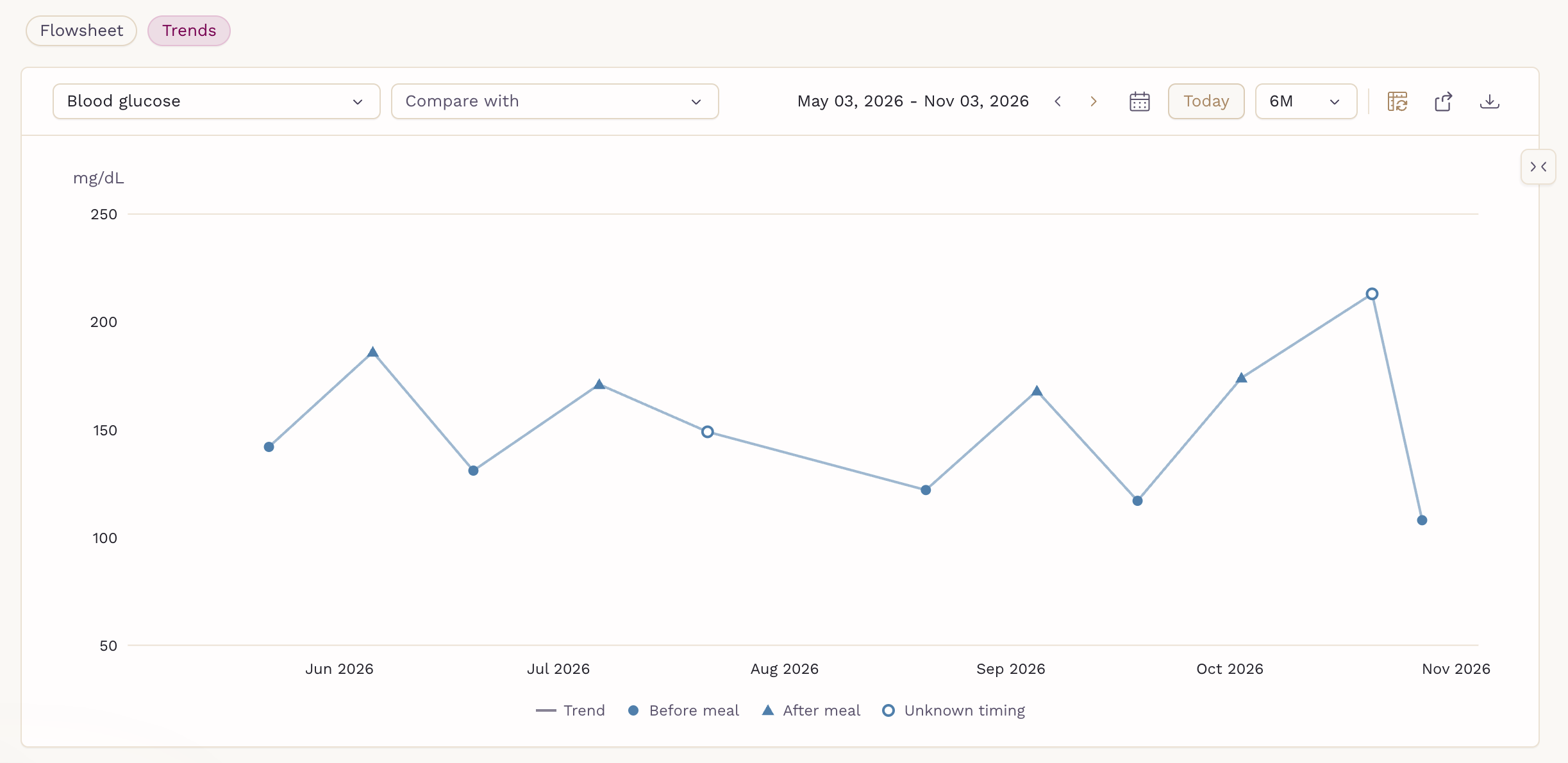
In SigmaMD, blood glucose is a standard vital in the clinician web app and the clinician mobile app. Each reading carries a Timing field, before meal or after meal, and a reading saved without one shows as "Unknown timing" so it is never mistaken for either. The practice sets its own normal ranges in Practice Settings, with separate before-meal and after-meal ranges for each age group and sex at birth. SigmaMD checks every reading against the range that matches its timing and flags the ones outside it in the chart. A reading with unknown timing is checked against the after-meal range, and the warning says so.
The Trends view plots glucose over time. A clinician can show all readings, with the dot shape marking each one's timing, or plot before-meal and after-meal readings side by side, each with its own threshold band. Glucose can be compared against weight on the same timeline, which is often the picture a GLP-1 patient most wants to see.
For the check-ins themselves, the SigmaMD Form Library includes a GLP-1 Weight Management Eligibility Screening form and a GLP-1 Check-In Tracker, which a practice adds and adjusts to its own protocol. The eligibility form covers weight and goals, past treatment, thyroid history, diabetes, mood and pregnancy. The check-in form asks for today's weight, the current medicine and last dose, missed doses, side effects by severity, warning signs, eating, fluids, activity and mood. A practice can send the check-in from an appointment type, so every follow-up booking sends it automatically, and the patient completes it on a phone or computer before the visit.
How do Scribe and Sigma AI fit into a GLP-1 follow-up?
Sigma AI answers questions about the chart in plain language. A clinician preparing for a follow-up can ask for the patient's glucose readings since the last dose change, and Sigma AI lists them with their timing and whether each one fell outside the before-meal or after-meal range, with every answer linked back to the record it came from. Its chart summary also lists forms that were submitted but not yet reviewed, so a check-in with a warning sign does not sit unread.
SigmaMD Scribe drafts the visit note from the conversation, in the structure of the practice's own note templates and snippets. A note template can pull the before-meal or after-meal glucose trend straight into the note. After the note is generated, Scribe suggests chart updates from what was said, including vitals, so a glucose reading the patient mentions in the visit can be added with its timing in a click. The clinician reviews and signs everything.
For the business side of these programs, see how GLP-1 era practices build direct-care memberships and starting an endocrinology direct care practice.
Where to start
Look at the last ten glucose readings in a few charts. How many say when they were taken? Then look at the last month of GLP-1 follow-ups. Did each patient report weight, dose, side effects and warning signs before the visit? If either answer is "not many", those two fixes, timing on every reading and a standard check-in before every follow-up, will do more than any other change.
To see glucose timing, GLP-1 check-ins, Sigma AI and Scribe working through a real follow-up, book a demo of SigmaMD.
See SigmaMD in Action
A 30-minute walkthrough to review your workflow in SigmaMD and answer your questions.
Book a demo