
Which Screening Questionnaires Belong in a Cash-Pay Behavioral Health Practice? PHQ-9, GAD-7, ASRS, MDQ and How Scoring Works
The screeners a cash-pay behavioral health practice should run, PHQ-9, GAD-7, ASRS, MDQ, AUDIT-C and CRAFFT, with cutoffs, repeat intervals and how scoring works.

Most cash-pay behavioral health practices need five screeners as a baseline: the PHQ-9 for depression (with the PHQ-2 as a quick first pass), the GAD-7 for anxiety, the ASRS-v1.1 for adult ADHD, the MDQ for bipolar spectrum symptoms, and the AUDIT-C for alcohol use. Add the CRAFFT if you see adolescents, and the DAST-10 when drug use is on the table. Each one only helps if it is scored correctly and someone reviews the result before the visit, not after.
This guide covers what each screener measures, where its cutoff sits, how often to repeat it, and how to set up scoring so the total reaches the clinician instead of sitting unread in a file.
Why does a cash-pay practice need validated screeners at all?
A practice outside insurance has no payer asking for a PHQ-9 on file. The reasons to use one are clinical. The U.S. Preventive Services Task Force recommends screening all adults for depression and adults under 65 for anxiety, and screening adults for unhealthy alcohol use. A validated instrument gives a number that means the same thing from one visit to the next, and that is what measurement-based care runs on.
For a membership practice, the follow-up scores are the part that matters most. A patient paying out of pocket wants to see that treatment is working. A PHQ-9 that drops from 18 to 7 over three months shows progress in a way "feeling a bit better" does not, and it tells the clinician when to change course.
Which screeners should a behavioral health practice use, and what are the cutoffs?
The table below lists the screeners most cash-pay behavioral health and direct primary care practices run, with the published scoring and a practical repeat interval. The cutoffs are screening thresholds, not diagnoses. A positive screen means the clinician should look further.
| Screener | What it screens for | Screens positive at | When to give it |
|---|---|---|---|
| PHQ-2 | Depression (first pass) | 3 or more: give the full PHQ-9 | Every intake; annually, or at any visit where mood comes up |
| PHQ-9 | Depression severity | 10 or more: moderate or worse. Any answer above zero on item 9 needs a same-day suicide risk assessment | Intake, then every 4 to 6 weeks while treating |
| GAD-7 | Generalized anxiety | 10 or more: further evaluation | Intake, then at follow-ups while treating |
| ASRS-v1.1 (Part A) | Adult ADHD | 4 or more answers in the shaded boxes: symptoms highly consistent with adult ADHD | When attention or focus is the complaint, before an ADHD evaluation |
| MDQ | Bipolar spectrum | Yes to 7 or more of 13 items, symptoms at the same time, and moderate or serious problems | Before starting an antidepressant; when depression does not respond |
| AUDIT-C | Hazardous drinking | 4 or more in men, 3 or more in women | Intake and annually |
| CRAFFT | Adolescent substance use (12 to 21) | 2 or more Yes answers in Part B | Every adolescent visit |
| DAST-10 | Drug use problems | 3 to 5: moderate, further investigation; 6 or more: intensive assessment | When substance use is suspected |
| PSS-10 | Perceived stress | No diagnostic cutoff; read the total as a trend | Intake and follow-ups in stress-related care |
Two rules hold across the whole set. Score the instrument the way it was published, because a cutoff only means something on the scoring it was validated with. And read the item-level answers, not just the total. A PHQ-9 total of 6 is mild, but if one of those points came from item 9, that patient needs a suicide risk assessment that day.
What does a sensible screening workflow look like?
Most practices settle on three layers:
- At intake: PHQ-9, GAD-7 and AUDIT-C for every adult, plus the ASRS or MDQ when the presenting concern points that way. The CRAFFT replaces the AUDIT-C for patients aged 12 to 21.
- At follow-up: repeat the instrument tied to what you are treating, every 4 to 6 weeks while a medication or therapy plan is being adjusted. Using the same instrument each time is what makes the scores comparable.
- Before key decisions: an MDQ before starting an antidepressant, so a bipolar spectrum presentation is caught before an SSRI is prescribed.
Send screeners before the visit, not in the waiting room. When the patient completes the forms at home, the clinician walks in already knowing the scores and can spend the visit on what they mean. In a direct-care practice that sees fewer patients a day, with longer visits than conventional insurance-based primary care, that preparation time is part of the model.
Where do screening programs break down?
Three problems come up again and again:
- Homemade versions. A PHQ-9 retyped from memory, with reworded items or a different answer scale, no longer matches the validated instrument, and its cutoffs no longer apply.
- Optional items. If a patient can skip a scored question, the total comes out quietly lower than it should, and a positive screen can read as negative.
- Scores nobody sees. A form submitted to a portal and filed as a PDF has done nothing until a clinician reads it. Unreviewed screens carry risk, especially when a suicide item is positive.
How does SigmaMD handle scored screening forms?
In SigmaMD, the Form Library includes SigmaMD-maintained versions of the screeners in the table, among them the PHQ-2, PHQ-9, GAD-7, ASRS-v1.1, MDQ, AUDIT-C, AUDIT, CRAFFT, DAST-10, CAGE-AID and PSS-10. Each carries the instrument's published wording, its published scoring, and the interpretation text for the clinician. A practice adds the ones it wants with a click. The published screeners stay read-only, so the wording cannot drift, and a practice that wants to adapt one duplicates it into its own editable copy. Every scored question is required, so a skipped item cannot pull the total down.
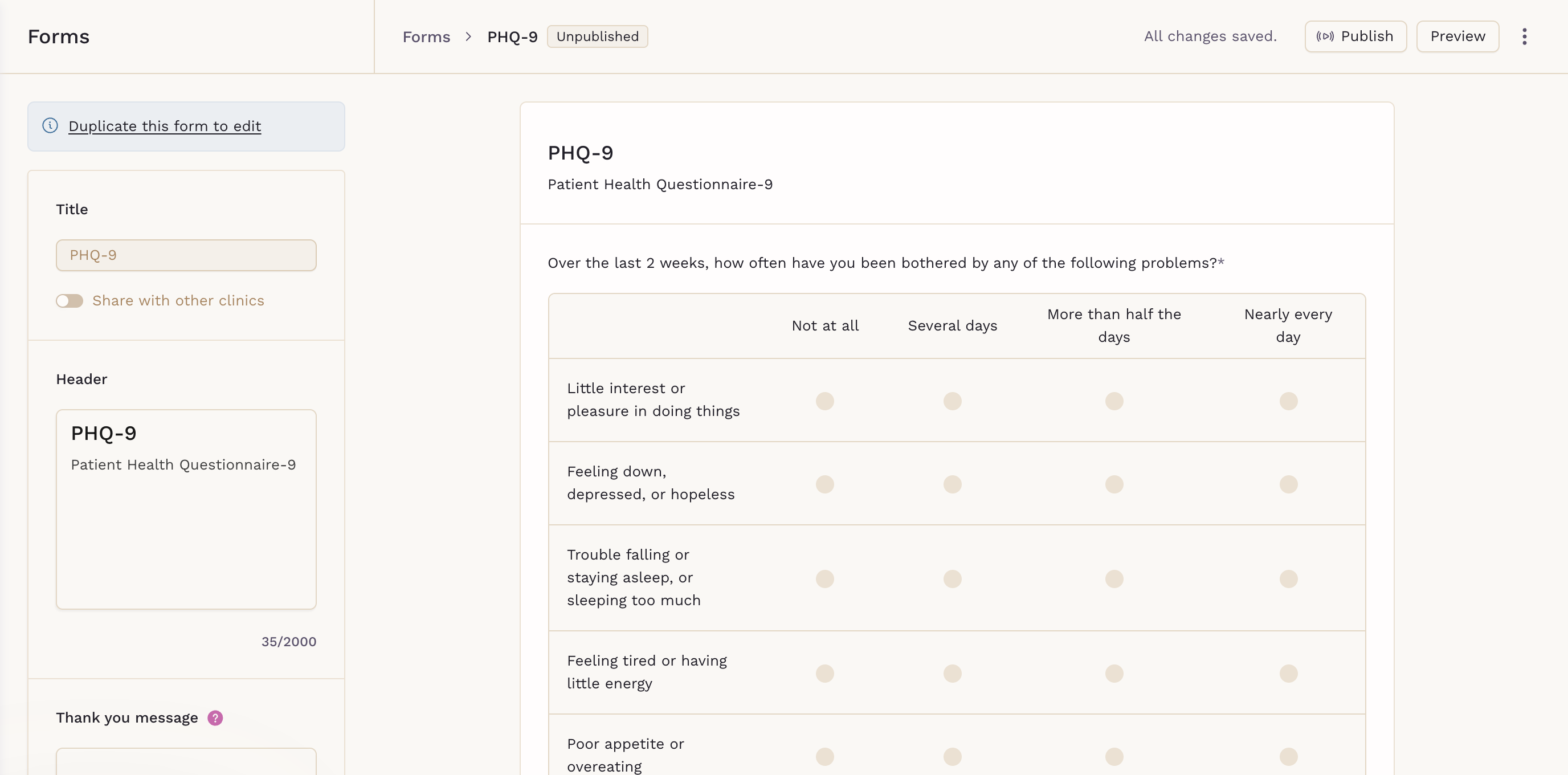
Patients complete the forms on a phone, tablet or computer, from an emailed link, the patient portal, or the SigmaMD patient app. They see only the questions and answer choices, never the scores or thresholds, which keeps the answers honest. A practice can attach forms to an appointment type, so a new-patient booking sends the intake screeners automatically, or group forms into a package and send them together. When a patient cannot fill one in alone, the clinician can lock the form and enter the answers in the room.
Once a patient submits, SigmaMD adds up the score and shows it to the clinician in the Forms tab of the chart. The response shows the score next to the instrument's interpretation ranges, so the clinician reads the cutoffs and the item-level answers side by side.
How do Scribe and Sigma AI fit into the screening workflow?
Sigma AI makes sure the scores get read. Its one-click chart summary lists any form the patient submitted that has not been reviewed yet, and any form that was sent and never answered, each linked to the form itself. A clinician opening the chart before a follow-up sees "PHQ-9 submitted, not reviewed" at the top instead of finding it later. Sigma AI can also answer questions about the chart during the visit, and every answer links back to the record it came from, so the clinician can check it.
SigmaMD Scribe handles the note. A note template can pull the patient's submitted screener, with its total, straight into the note, and Scribe drafts the rest of the visit from the conversation, in the structure of the practice's own note templates and snippets. The clinician talks with the patient about what the score means, then reviews and signs the draft. The screen, the conversation about it, and the plan end up in the same note.
For the wider picture of running a practice outside insurance, see what cash-pay behavioral health practices need from their software and membership models for direct-care psychiatry.
Where to start
Pick the three screeners your clinicians use most and check them against the table. Is each one the published version, scored as published, with every item required? Does it reach the clinician before the visit? Does someone review every submission? Those three checks close most of the gaps in a screening program.
To see scored forms, Sigma AI and Scribe working through a real behavioral health visit, book a demo of SigmaMD.
See SigmaMD in Action
A 30-minute walkthrough to review your workflow in SigmaMD and answer your questions.
Book a demo